Certificate of Free Sale (CFS)
Dietary supplements, medical foods and foods for special dietary use.
Ecuador has applied the Hague Apostille Convention since 2 April 2005. An FDA certificate filed with ARCSA, Ecuador's health regulator, needs a U.S. Department of State apostille and nothing more. You don't need Ecuadorian consulate legalization. Upload your digital certificate and we return it apostilled by FedEx.
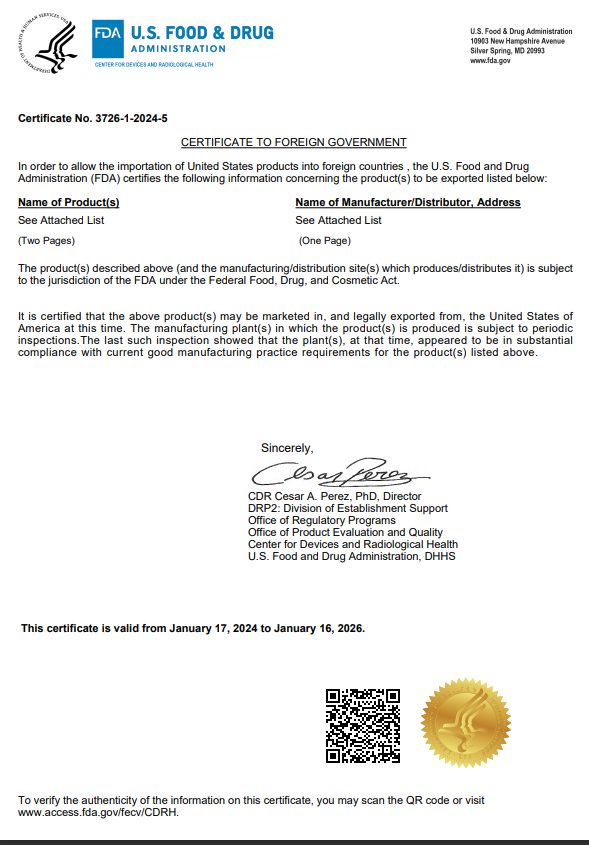
Simply upload your FDA digital file, and you will receive your apostilled document via FedEx.
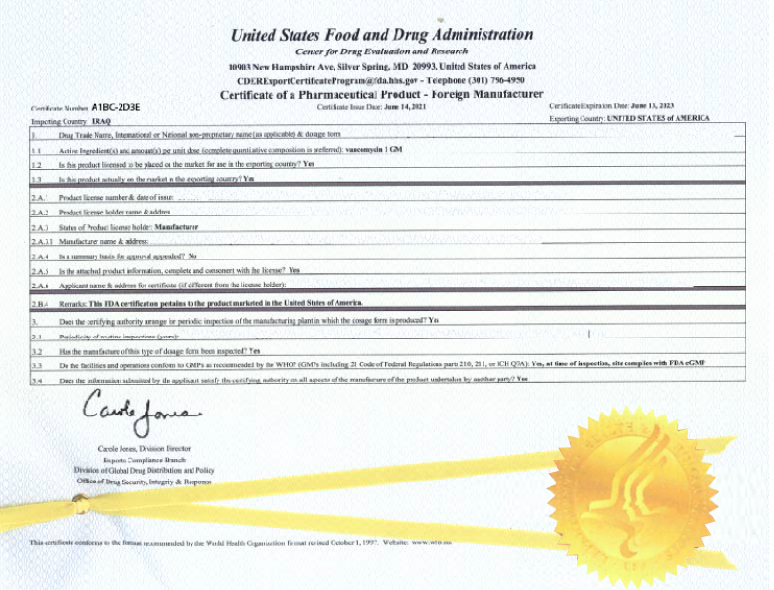
Every medicine, medical device, food and cosmetic sold in Ecuador needs a sanitary registration or notification from ARCSA, the national health regulatory agency. Foreign registration files rely on documents from the country of origin. For U.S. products that means an FDA certificate, and ARCSA accepts it apostilled.
For medicines, Ecuador offers a faster route called homologation. It recognizes registrations granted by high-surveillance regulators. ARCSA asks for a valid WHO-model Certificate of a Pharmaceutical Product (or a Certificate of Free Sale) from the country of origin, together with an apostilled copy of the reference registration. A U.S. CPP is the standard way to meet this, and we handle its State Department apostille.
Match your product to the Ecuadorian authority that reviews it and the FDA certificate that authority normally expects.
| Product type | Ecuadorian authority | FDA certificate |
|---|---|---|
| Medicines | ARCSA (Agencia Nacional de Regulación, Control y Vigilancia Sanitaria) | Certificate of a Pharmaceutical Product (CPP), Certificate of Exportability |
| Medical devices | ARCSA | Certificate to a Foreign Government (CFG), Certificate of Exportability |
| Processed food & infant formula | ARCSA | Certificate to a Foreign Government (CFG), Health Certificate |
| Dietary supplements & medical foods | ARCSA | Certificate of Free Sale (CFS) |
| Cosmetics & personal care | ARCSA, applying Andean Community (CAN) cosmetic rules | Certificate for Cosmetics |
ARCSA reviews all of these product groups, but each category follows its own procedure. Cosmetics fall under Andean Community notification rules shared with Colombia, Peru and Bolivia. Your Ecuadorian registration holder will confirm the exact certificate and wording for your product.
The Hague Apostille Convention has been in force for Ecuador since 2 April 2005, so a single apostille from the U.S. Department of State makes your FDA certificate valid there. There is no embassy visit, consular stamp or second legalization step.
Send the digital certificate exactly as the FDA issued it and choose Ecuador as the destination.
We check that the certificate is complete, FDA-signed and ready for the State Department.
We submit it to the Office of Authentications and track it until the apostille is issued.
The apostilled certificate ships to you, your importer or your agent in Quito or anywhere else.
For medicine homologation, ARCSA expects the CPP or Certificate of Free Sale to show the product name, strength, dosage form, full qualitative and quantitative formula, and the manufacturer's name, city and country. Check your FDA certificate covers these before you apostille it.
ARCSA requires an official Spanish translation of foreign documents written in another language. Some English technical documents may be accepted as they are. Translate the FDA certificate after the apostille is attached so the apostille is translated too.
Registrations are filed through Ecuador's single window (VUE) by an applicant with an Ecuadorian tax number (RUC), normally your importer or legal representative. Make sure the company names on the FDA certificate match their file.
ARCSA medicine registrations through homologation are valid for five years. Keep your FDA certificate current so renewals and variations aren't held up waiting for a new apostilled document.
| Item | Amount | Notes |
|---|---|---|
| Our service fee | $68 / doc. | Review, submission, tracking and FedEx dispatch |
| U.S. Department of State fee | $20 / doc. | Paid by us on your behalf |
| Total | $88/ doc. | Standard processing: 9 business days. Expedited options available. |
Yes. Ecuador joined by accession, and the Convention has applied there since 2 April 2005. A U.S. Department of State apostille is enough, so no Ecuadorian embassy or consulate legalization is needed.
Homologation lets ARCSA register a medicine based on its approval by a high-surveillance regulator. It asks for a valid WHO-model Certificate of a Pharmaceutical Product (or a Certificate of Free Sale) and an apostilled copy of the reference registration. For U.S. drugs, that is an FDA CPP.
Yes, in most cases. ARCSA asks for an official Spanish translation of foreign documents in another language. Translate the certificate after it is apostilled so the apostille is included.
Typically a CFG for medical devices and conventional foods, a Certificate of Free Sale for dietary supplements, and a Certificate for Cosmetics for cosmetic products, which follow Andean Community rules. Products not sold in the U.S. need a Certificate of Exportability.
Yes. We ship by FedEx using our label or your own FedEx account, to you or directly to your importer or registration holder anywhere in Ecuador.
Standard processing takes 9 business days and costs $88per document: our $68 service fee plus the $20 U.S. Department of State fee. Expedited options are available.
Dietary supplements, medical foods and foods for special dietary use.
Medical devices, conventional foods, food additives and infant formula sold in the U.S.
The WHO-format certificate used to register human drugs.
Products made in the U.S. for export only.
Collagen and gelatin exports (EU health certificate or SRM certificate).
Skincare, makeup, haircare and fragrance products.
Upload your FDA certificate today and receive it apostilled by FedEx in 9 business days, for $88per document with the State Department fee included.
Start Your Order Ask a Question
Simply upload your FDA digital file, and you will receive your apostilled document via FedEx.